Campervans with pop-top roofs have become increasingly popular with buyers looking for extra sleeping space without moving to a larger vehicle. A pop-top can turn a compact campervan into practical accommodation for up to four people, making it an attractive option for couples, families and anyone who occasionally travels with extra passengers.
But is a pop-top roof worth the additional cost? And how does it compare with a campervan that has a conventional fixed roof?
At Southdowns Motorhomes, we offer a range of campervans with different layouts and roof configurations, including pop-top models from manufacturers such as HYMER and Burstner.
In this guide, we look at the advantages and disadvantages of pop-top roofs, how they work and what you should consider before choosing one.
What Is a Pop-Top Roof on a Campervan?
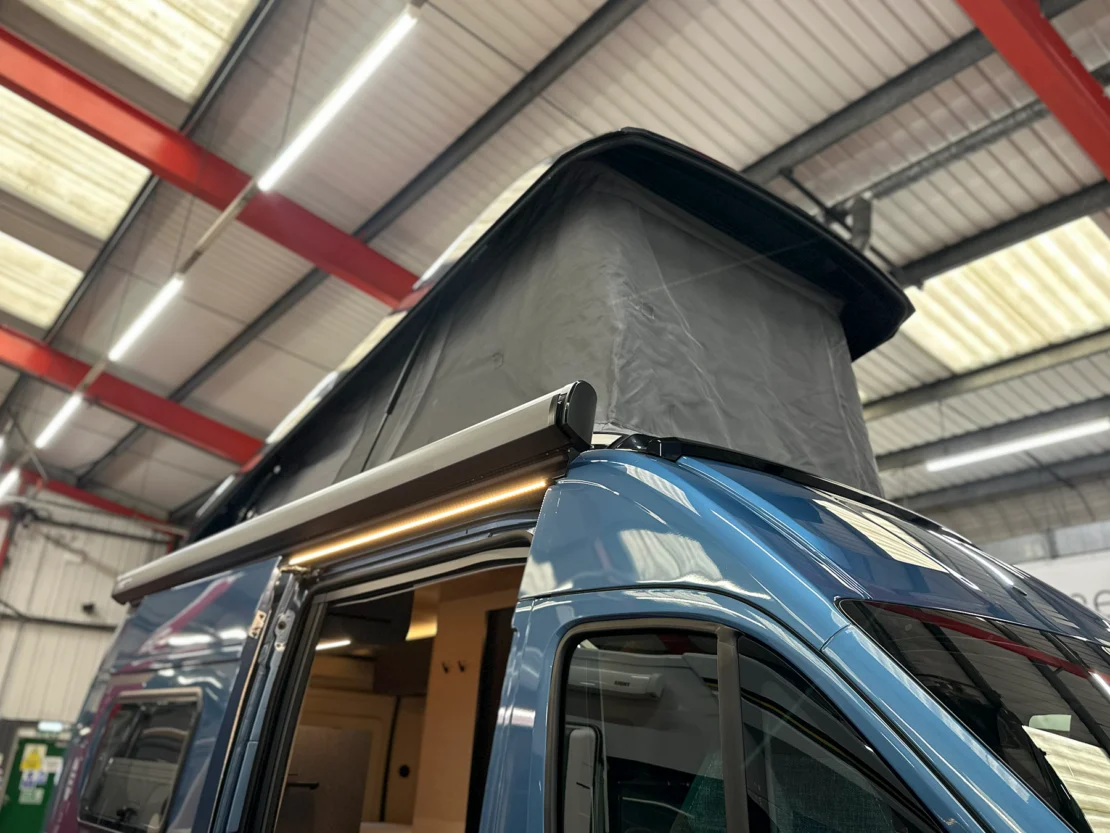
A pop-top roof is a section of the campervan’s roof that can be raised when the vehicle is parked. Depending on the design, it may lift at one end or rise more evenly to create an additional space above the main living area.
On many modern campervans, the raised roof houses a separate sleeping compartment, complete with a mattress, ventilation panels and windows.
When travelling, the roof folds down into a compact position, keeping the vehicle relatively low compared with some traditional high-roof designs.
Pop-top roofs are available on a wide range of campervans, from smaller leisure vehicles to larger van conversions built on platforms such as the Fiat Ducato and Mercedes-Benz Sprinter.
Some manufacturers offer pop-top roofs as an optional extra, while others include them as part of a particular model’s specification.
What Are the Benefits of a Campervan Pop-Top Roof?
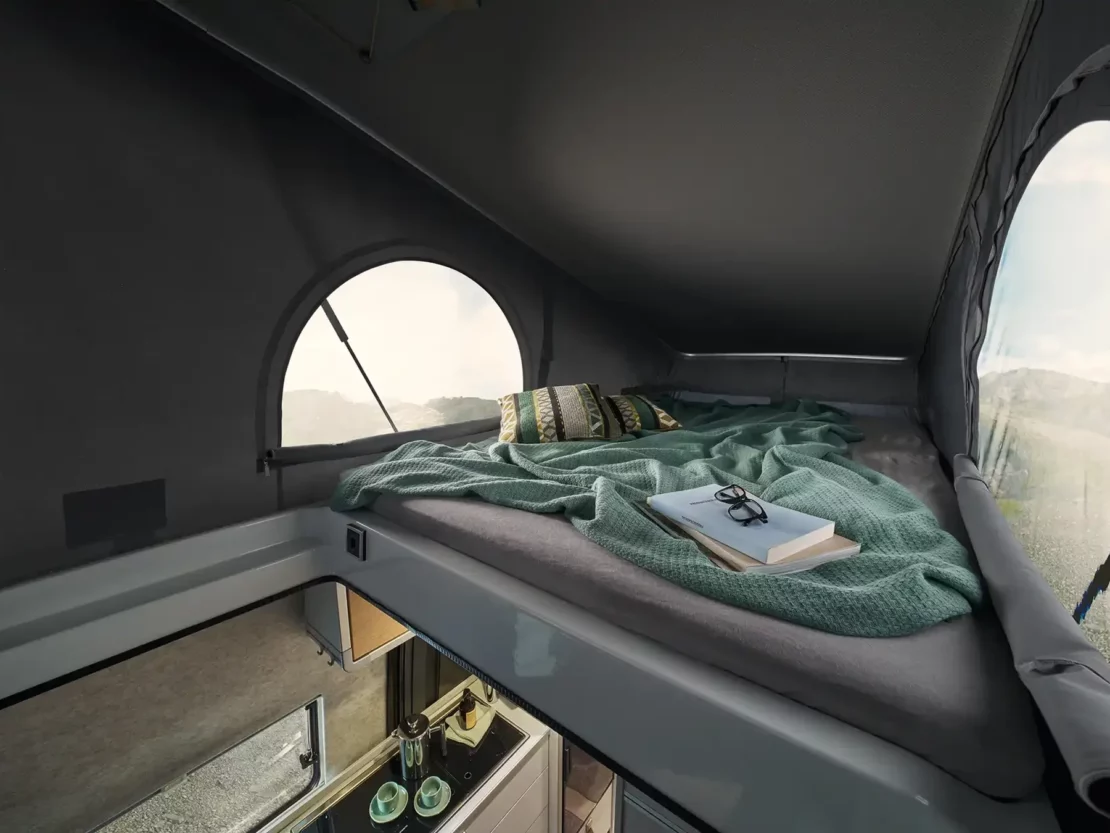
1. Extra Sleeping Space Without a Larger Campervan
One of the biggest reasons to choose a pop-top roof is the additional sleeping accommodation.
Many campervans are designed primarily for two people, with a fixed or convertible bed in the main living area. Adding a pop-top roof can provide a second sleeping area without significantly increasing the vehicle’s length.
This can make a considerable difference for families travelling with children or couples who occasionally want to accommodate friends or grandchildren.
For example, certain HYMER and Burstner campervans can provide four sleeping berths when fitted with a pop-top roof.
It means you can enjoy the practical dimensions of a compact campervan while having greater flexibility when travelling with additional people.
It is important, however, to check the number of approved travelling seats as well as sleeping berths. A four-berth campervan does not automatically have four seatbelts.
2. More Flexibility for Families
A pop-top roof can make family trips considerably easier.
Rather than converting the main seating area into an additional bed every evening, children or other passengers can use the upper sleeping compartment while the main bed remains available below.
This arrangement can give everyone a little more privacy and allow different members of the family to settle down at different times.
For families who regularly take weekend breaks or longer holidays, having a separate sleeping space can make a relatively compact campervan feel much more practical.
It is worth checking the manufacturer’s guidance on minimum ages, maximum bed loads and safe access before allowing children to use the upper bed.
3. Compact Dimensions for Everyday Driving
A key advantage of many pop-top campervans is that they retain relatively compact dimensions when the roof is closed.
Unlike a permanently raised roof, a pop-top can provide additional accommodation without a substantial increase in overall travelling height.
This can make the vehicle easier to manage on narrower roads and when travelling through towns or villages.
However, not every pop-top campervan will fit into a standard car park or garage. Overall height varies considerably between vehicles, particularly larger campervans with raised base roofs, roof-mounted accessories or four-wheel-drive configurations.
Always check the manufacturer’s specified travelling height before entering height-restricted areas.
4. A Separate Sleeping Area
A pop-top creates a sleeping space away from the main living accommodation.
This is particularly useful when several people are sharing a campervan.
For example, children may be able to go to bed in the roof compartment while adults continue using the seating area below.
In some campervans, the upper bed can also be used for occasional guests without requiring substantial changes to the main layout.
The amount of privacy and separation depends on the specific pop-top design, so it is worth viewing the sleeping compartment in person.
5. Ventilation and Views
Many modern pop-top roofs incorporate fabric side panels with windows, ventilation openings or mesh sections.
These can allow fresh air to circulate through the upper sleeping area during warmer weather.
Some designs also offer panoramic openings, making the roof compartment particularly pleasant when parked somewhere scenic.
Being able to open the roof windows on a warm summer evening can make sleeping in the upper compartment more comfortable.
Of course, ventilation features vary between manufacturers and models, and the roof should always be used in accordance with the manufacturer’s instructions.
What Are the Disadvantages of Pop-Top Campervan Roofs?
Although a pop-top roof can be a useful addition, it is not necessarily the right choice for every campervan buyer.
There are several practical considerations worth understanding before making a decision.
1. Additional Purchase Cost
A pop-top roof generally increases the purchase price of a campervan compared with an otherwise similar specification without one.
The additional cost depends on the manufacturer, vehicle and roof system.
Factory-fitted pop-top roofs can incorporate dedicated sleeping platforms, mattresses, ventilation systems, lighting and lifting mechanisms, all of which contribute to the price.
If you regularly travel with three or four people, the added sleeping accommodation may justify the investment.
However, if you predominantly travel as a couple and rarely need additional beds, the money might be better spent on other features that you will use more frequently.
2. Less Insulation Than a Fixed Roof
Many pop-top roofs use flexible fabric sides when raised. These are generally less insulated than the solid roof and walls of a conventional campervan.
As a result, the upper sleeping area may feel colder in winter and can be more affected by external noise.
This is particularly relevant for anyone planning to use their campervan throughout the year in the UK.
Some pop-top systems offer additional insulating covers or thermal accessories that can improve comfort during colder weather.
If you regularly tour during autumn and winter, it is worth considering how often you would realistically use the upper bed.
3. Wind and Bad Weather
Pop-top roofs are designed for outdoor use, but exposed campsites and strong winds can make the raised roof less comfortable.
The fabric panels may move or create noise in windy conditions, while heavy rain can make packing away the roof less convenient.
Manufacturers provide specific instructions about operating pop-top roofs in poor weather, and these should always be followed.
If the fabric is damp when the roof is lowered, it may need to be raised again once conditions improve so that it can dry properly.
For buyers who regularly use exposed coastal campsites or travel during the winter, this is an important practical consideration.
4. Additional Maintenance
A pop-top roof introduces components that require periodic inspection and care.
Depending on the design, these may include:
- Fabric side panels and seams
- Roof seals and weatherproofing
- Hinges, catches and lifting mechanisms
- Gas struts or electrically operated systems
- Roof windows and ventilation openings
Keeping the roof clean, ensuring the fabric is dry before extended storage and following the manufacturer’s servicing guidance will help maintain its condition.
A well-maintained pop-top should provide years of use, but it does introduce extra components compared with a conventional fixed roof.
5. Access to the Upper Bed
The upper sleeping compartment is normally reached through an opening in the roof, often using a ladder or integrated steps.
While this arrangement works well for many families, it may not suit everyone.
Access can be less convenient for people with limited mobility, and getting in and out of the upper bed during the night may be more difficult than using a bed in the main living area.
Before buying, we recommend climbing into the upper sleeping compartment to check that the access and sleeping arrangements are comfortable for you.
6. Additional Weight and Reduced Payload
A pop-top roof adds weight to the vehicle, which can affect its available payload.
Payload is the weight you can legally carry, including passengers, luggage and other items, within the vehicle’s permitted maximum weight.
This is particularly important for campervans with a maximum authorised mass of 3,500kg.
If you are choosing a pop-top campervan for family travel, check the available payload after accounting for passengers, accessories, water and luggage.
The effect on payload varies between models and specifications, so it is important to check the figures for the exact vehicle you are considering.
Pop-Top Roof vs Fixed Roof: Which Is Better?
Both options have their advantages, and the better choice depends largely on how you intend to use your campervan.
| Feature | Pop-Top Roof | Fixed Roof |
|---|---|---|
| Additional sleeping space | Often provides two extra berths | Depends on the interior layout |
| Weather insulation | Less insulated when raised | Generally better insulated |
| Purchase cost | Usually higher with the roof option | Often lower for a comparable vehicle |
| Maintenance | Additional roof components to maintain | Fewer moving roof components |
| Family touring | Particularly useful for extra berths | Depends on available beds and seats |
| Winter touring | Upper bed may be colder | Typically more comfortable |
| Overall vehicle height | Often compact when closed | Depends on vehicle design |
For couples who mainly travel together, a fixed-roof campervan may provide everything they need.
For families or anyone who wants occasional additional sleeping accommodation, a pop-top can make a significant difference without requiring a longer vehicle.
Are Pop-Top Campervans Suitable for Winter?
Yes, pop-top campervans can be used during winter, although the upper sleeping compartment may not offer the same level of insulation as the main body of the vehicle.
Most modern campervans have habitation heating systems designed to keep the main living area comfortable in colder conditions.
However, warm air may not circulate as effectively into the raised roof compartment, and fabric side panels generally lose heat more quickly than insulated walls.
For regular winter touring, it is worth looking at the insulation options available for the particular roof system.
If you expect to spend much of your time touring during colder months and rarely need extra sleeping accommodation, a fixed-roof campervan may be a more practical choice.
Are Pop-Top Roofs Worth the Extra Money?
Whether a pop-top roof is worth the additional cost depends on how frequently you will use it.
For a family of four, a pop-top can be an excellent way to provide everyone with a proper sleeping space while retaining the dimensions of a relatively compact campervan.
It can also be useful for couples who regularly travel with grandchildren or occasionally invite friends to join them.
On the other hand, if you mostly travel as a couple and have no plans to use the additional sleeping compartment, the benefits may be limited.
There is also the question of resale value. A pop-top roof may appeal to buyers looking for a four-berth campervan, but it does not necessarily mean that you will recover the full cost of the option when selling.
The most sensible approach is to consider how you plan to use the vehicle rather than choosing a pop-top simply because it is available.
Which Campervans Are Available With Pop-Top Roofs?
At Southdowns Motorhomes, we offer campervans from manufacturers including HYMER and Burstner, with pop-top roof options available on selected models.
Examples include:
HYMER Ayers Rock
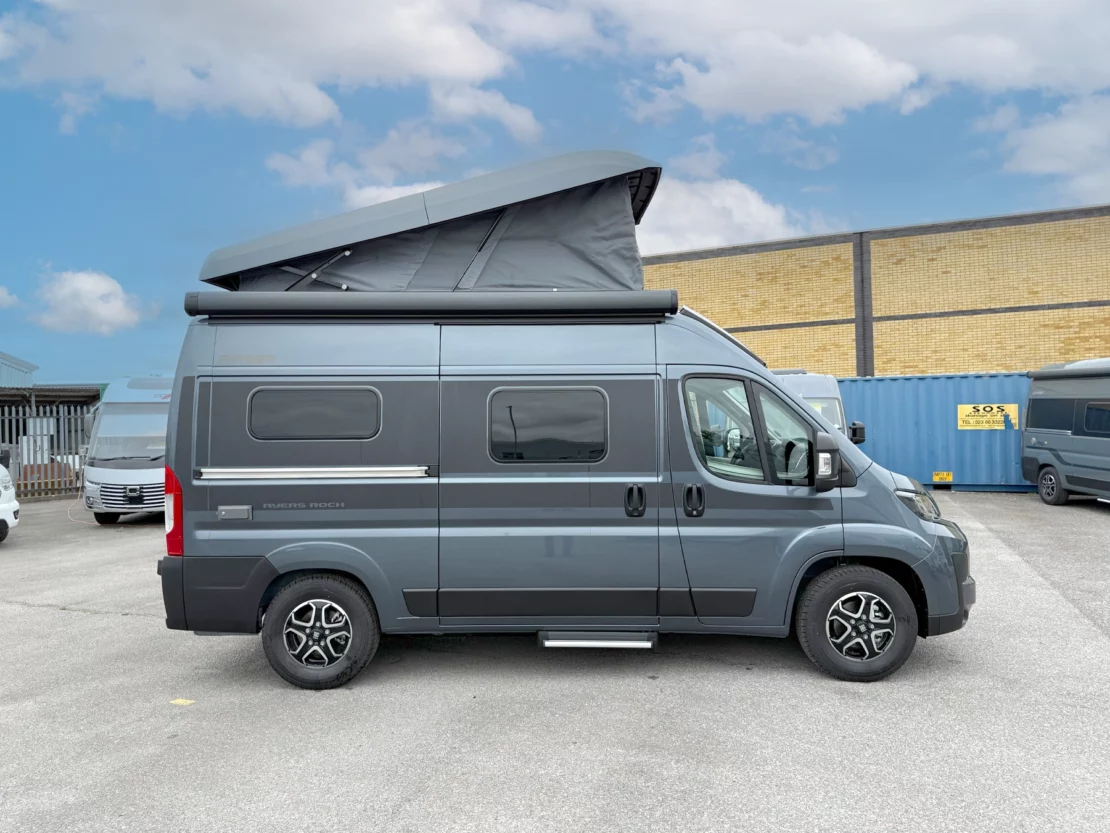
The HYMER Ayers Rock is a compact campervan designed for buyers who want a practical touring vehicle without moving to a larger motorhome.
Selected versions feature a pop-top sleeping roof, allowing additional passengers to sleep above the main living area.
Its compact length makes it particularly interesting for buyers looking for a manageable campervan with flexible sleeping arrangements.
HYMER Grand Canyon S
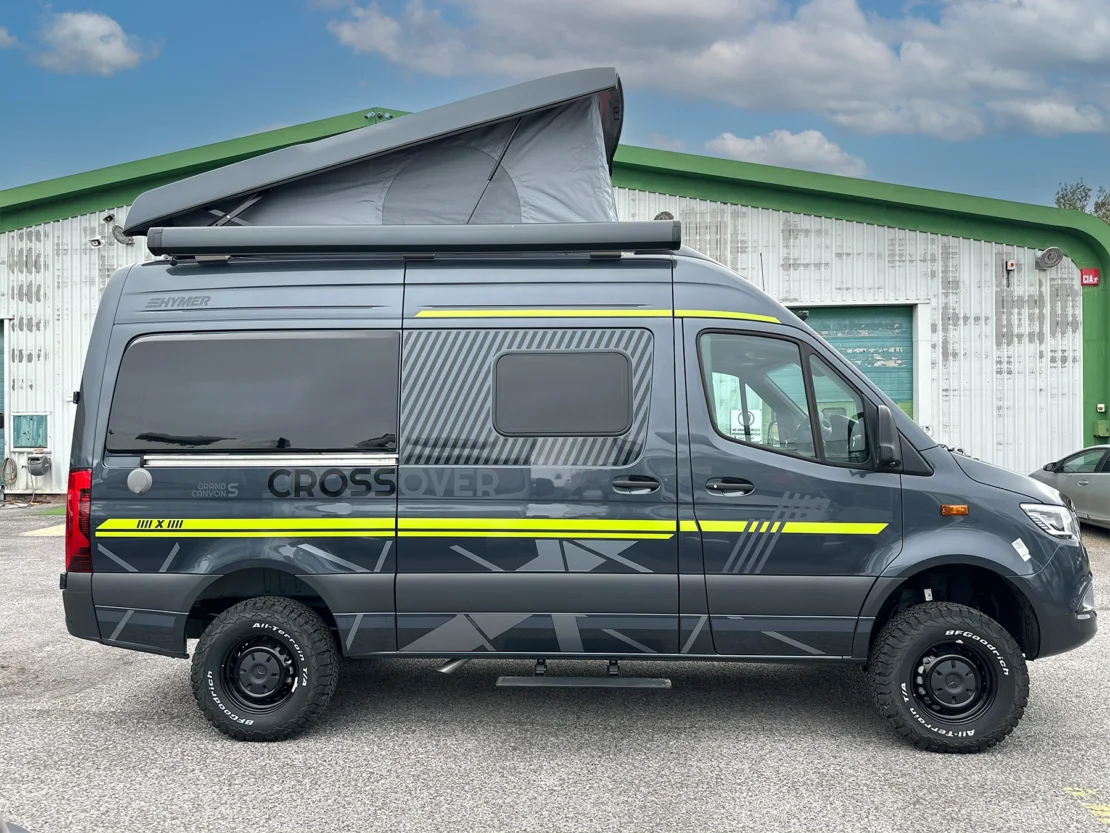
The HYMER Grand Canyon S combines the Mercedes-Benz Sprinter platform with a carefully planned interior.
Selected configurations are available with a pop-top roof, providing additional sleeping accommodation alongside the main rear bed.
It is an option worth considering for buyers who want a premium campervan with the flexibility to accommodate occasional extra passengers.
Burstner B66 Campervan
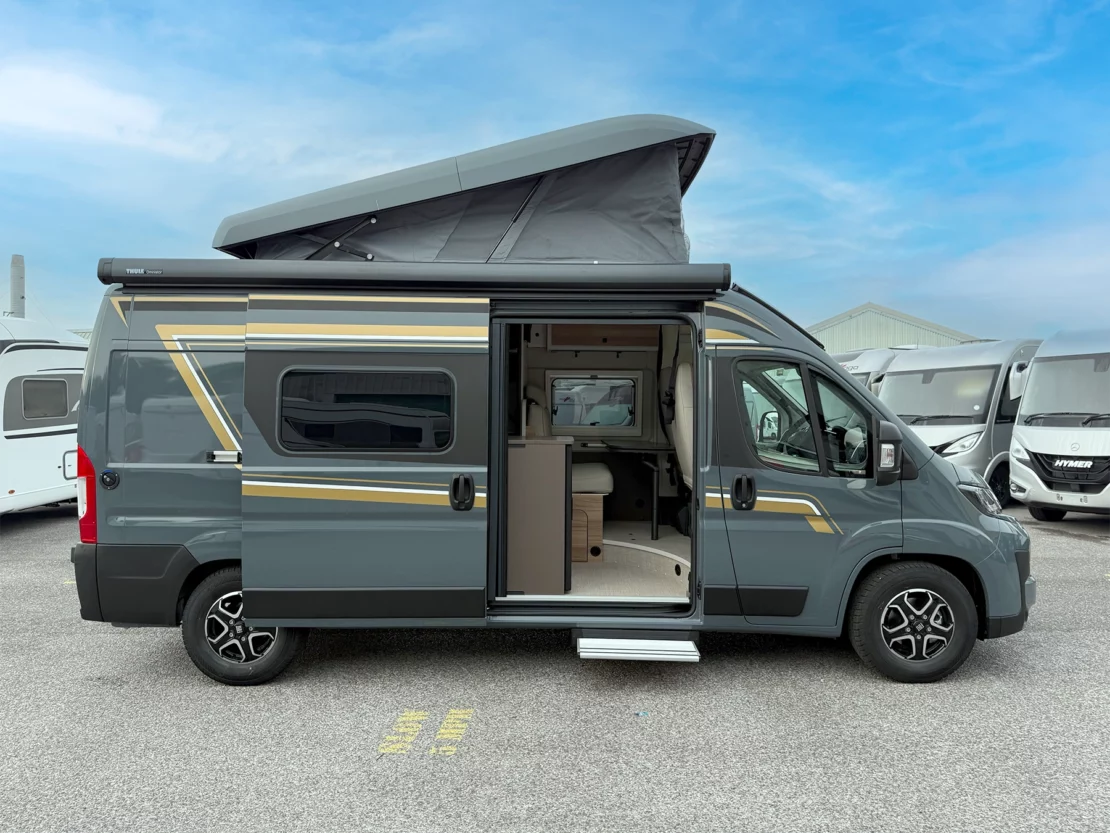
Selected Burstner B66 campervans can also be specified with a pop-top roof.
The additional sleeping compartment can make these vehicles particularly appealing to families who want a practical touring layout without moving to a larger motorhome.
The availability and specification of pop-top roofs vary between models, so it is worth comparing individual vehicles.
You can browse our campervans for sale to see the models currently advertised.
What Should You Check Before Buying a Pop-Top Campervan?
Before deciding whether a campervan with a pop-top roof is right for you, there are several things worth checking.
Sleeping comfort: Make sure the upper mattress is large enough and that the roof provides sufficient headroom when raised.
Access: Try climbing into and out of the upper bed to make sure the ladder or steps are suitable.
Roof operation: Ask for a demonstration of how the pop-top opens and closes. Check whether it operates manually or electrically.
Travelling seats: Confirm the number of approved seatbelt positions, especially if you intend to travel with children.
Payload: Check how much carrying capacity remains once the pop-top and any other fitted equipment are included.
Weather protection: Look at the fabric, seals, ventilation and any available insulation accessories.
Overall height: Confirm the vehicle’s travelling height with the roof closed, particularly if you have restrictions at home.
Warranty and servicing: Check the manufacturer’s maintenance requirements and warranty conditions for the roof system.
Viewing a pop-top campervan in person is one of the best ways to decide whether the additional accommodation will suit your needs.
Our Verdict: Is a Campervan Pop-Top Roof Worth It?
For the right buyer, a pop-top roof can be a worthwhile addition to a campervan.
The biggest benefit is the ability to add sleeping space without requiring a substantially larger vehicle. This makes pop-top campervans particularly appealing to families, couples travelling with grandchildren and anyone who wants greater flexibility from their vehicle.
However, the additional cost, reduced insulation in the raised compartment and extra maintenance requirements should all be considered.
If you primarily travel as a couple, a fixed-roof campervan may be the more straightforward option.
If you regularly need four sleeping berths but want to retain a compact vehicle, a pop-top roof could be well worth considering.
Explore Pop-Top Campervans at Southdowns Motorhomes
At Southdowns Motorhomes, we can help you compare campervan layouts, sleeping arrangements and roof options to find a vehicle that suits the way you travel.
Whether you are looking for a compact HYMER campervan or a larger Burstner model with additional sleeping accommodation, our team can talk you through the available options.
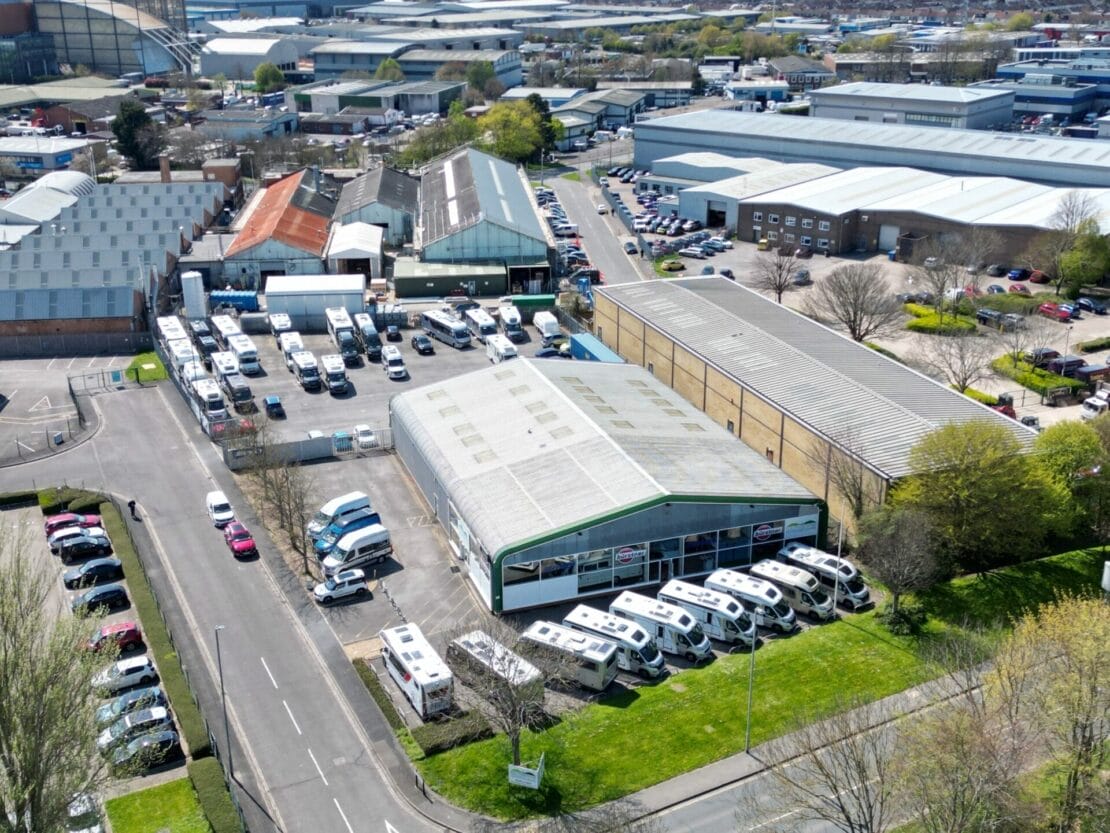
Browse our campervans for sale or contact Southdowns Motorhomes to arrange a visit to our Portsmouth showroom.
Seeing a pop-top roof in operation and trying the sleeping arrangements for yourself can make choosing the right campervan much easier.
FAQs
A properly fitted and maintained pop-top campervan roof should provide effective protection against rain. Modern pop-top roofs use weather-resistant fabrics, seals and carefully designed closing mechanisms to help keep water out. However, damaged seals, worn fabric or incorrect operation can lead to leaks. Regular inspections and following the manufacturer’s care instructions will help keep your pop-top roof in good condition.
Yes, you can sleep in a pop-top campervan roof during winter, although the upper sleeping area will generally be colder than the main living space. Fabric-sided pop-top roofs offer less insulation than a conventional fixed roof. Some manufacturers provide thermal covers or additional insulation to improve comfort. If you regularly tour during colder months, it is worth considering how well the pop-top sleeping area will suit your needs.
The additional cost of a pop-top campervan roof varies depending on the manufacturer, model and roof specification. Factory-fitted systems can include an upper bed, mattress, lighting and ventilation, which all influence the price. For families needing extra sleeping accommodation, the additional cost may be worthwhile. At Southdowns Motorhomes, we can help you compare campervan specifications and prices to find the right option for your budget.
No. A campervan pop-top roof must be fully lowered and securely locked before driving. Travelling with the roof raised can damage the roof mechanism and create a serious safety risk. Always check that the fabric is correctly folded away and all catches or locking mechanisms are secured before setting off. Follow the manufacturer’s operating instructions for your particular campervan.
A pop-top roof can affect campervan insurance, particularly if it has been fitted as an aftermarket conversion. Factory-fitted pop-top roofs are generally included in the vehicle’s original specification, but you should still confirm the details with your insurer. Any modifications should be declared to ensure your policy provides appropriate cover. Insurance costs will depend on the vehicle, roof installation and individual insurer.
A well-maintained campervan pop-top roof can last for many years, although its lifespan depends on the roof design, materials, frequency of use and maintenance. Regularly checking the fabric, seals, hinges and lifting mechanism can help prevent problems. Allowing wet roof fabric to dry thoroughly before extended storage is also important. Following the manufacturer’s servicing recommendations will help keep your pop-top roof working properly.
Written by the Southdowns Motorhomes team. With decades of experience supplying premium motorhomes to UK and European customers, our team understands what makes a vehicle suitable for serious touring.