Travelling in your motorhome through Europe is an exciting way to explore. But it also means you must meet specific legal and practical requirements before you set off. This guide gives a clear breakdown of what you need to know and do.
The below is just a guide, correct at time of press. If you’re planning a European trip, ensure you check all the latest rules and regulations for each country you’re planning to travel through.
We’ve also written a handy packing checklist for European motorhome travel which you may find useful.
Driving licence & vehicle entitlement
As a UK‑based driver:
- If you hold a UK photocard driving licence which authorises you to drive your motorhome, you may drive in EU/EEA countries (and Switzerland, Iceland, Liechtenstein) without needing an International Driving Permit (IDP).
- If your licence is an older paper version, or you were issued via Gibraltar, Guernsey, Jersey or the Isle of Man, then you may need an IDP.
- It’s essential to check that your licence category covers the vehicle category you will be driving abroad. For example, if your motorhome’s Maximum Authorised Mass (MAM) is over 3,500 kg, you may need a different licence category than would be required for a standard car.
- Bear in mind: rules can diverge between countries, especially outside the EU/EEA, so always check for each destination.
Vehicle registration, tax, MOT & insurance
Before you travel:
- Your motorhome must be correctly registered in the UK and taxed, and if it’s due a MOT (or equivalent) it must be valid.
- Carry your V5C (vehicle log book) so you can prove registration.
- UK‑issued vehicle insurance should cover you for driving in a number of European countries-but you should check the terms carefully and find out whether you need a “green card” (an international insurance certificate) for certain destinations.
- If your MOT or tax expires while you are abroad, you might face difficulties returning home or renewing from abroad.
UK sticker, number‑plate and required equipment
When driving abroad you should check and comply with these:
- UK‑registered vehicles must display the “UK” identifier sticker on the rear unless the number plate already includes the UK identifier with the Union Jack. For some countries (for example Spain, Malta, Cyprus), the UK sticker is required even if your plate shows the UK code.
- Many countries require you to carry specific equipment: warning triangle(s), high‑visibility jacket(s) (usually one for each occupant), headlamp beam converters (if applicable for driving on the right side), spare bulbs, etc.
- If your motorhome weighs over certain thresholds (for example over 3.5 t) or is towing a trailer, you may need additional stickers (such as blind‑spot warning stickers in France) or comply with special rules for large vehicles.
Compliance with local rules and standards
Every country you travel through can have its own rules on: speed limits, drink‑driving limits, emissions zones, tolls or vignettes, head‑lamp adjustment for right‑hand traffic, etc.
- For example, in France, motorhomes over 3.5 t may need to display blind‑spot stickers.
- Many French cities and other European capitals have low‑emission zones – you’ll need the correct sticker (vignette) for your vehicle or risk fines.
- Research all countries on your route: check for toll systems, required vignettes, parking or overnight stop restrictions for motorhomes, and whether any specific rules apply to the size or class of vehicle you’re driving.
Towing and combined vehicles
If you plan to tow a trailer or caravan behind your motorhome:
- Ensure your licence allows for the combined weight of motorhome + towed trailer. Foreign countries may treat towed combinations differently from the UK.
- The trailer must be registered, taxed and insured as required, and meet the equipment and safety requirements for both the UK and the countries you’ll drive through.
Documents and proof you should carry
When driving your motorhome abroad, we recommend carrying:
- Your valid passport (check expiry and any entry/exit rules).
- Your UK driving licence.
- The vehicle log book (V5C).
- Proof of motorhome insurance (and green card certificate if required).
- Your UK “UK” identifier sticker (if needed).
- Breakdown cover that is valid for Europe (helpful in case of issues abroad).
- Required equipment: warning triangle(s), hi‑vis jacket(s), headlamp converters (if needed), spare bulbs, etc.
- For each country you travel through: a print‑out or list of relevant regulations (e.g., emissions zones, tolls, other requirements).
- A copy of The Certificate of Conformity (CoC) – more about this below.
The Certificate of Conformity (CoC) – what is it and when you may need it
What is a CoC?
A Certificate of Conformity (CoC) is a document issued by the vehicle manufacturer which confirms that the vehicle was produced in conformity with a relevant type‐approval standard (for example under EU regulation) and records key technical data about the vehicle: mass, dimensions, engine size/performance, manufacturer details, date of manufacture, etc.
When is it needed?
- In the UK, manufacturers of new vehicles sold under EU Whole Vehicle Type Approval must supply the original CoC to the buyer at delivery free of charge.
- If you are importing a vehicle that was originally registered in the EU or are exporting a UK vehicle to EU countries, you may encounter authorities asking for a CoC to prove type approval compliance.
Does that mean you must carry it when driving through Europe?
- The CoC is primarily a document for registration/approval purposes rather than routine checks at borders.
- That said: if you are taking your UK registered motorhome through Europe, especially if traversing countries with stricter checks or travelling for extended periods, having a copy of the CoC (not the original as this may be costly to replace if lost) may be helpful to demonstrate your vehicle meets the necessary technical standards.
Our advice at Southdowns Motorhomes:
- If your motorhome is UK‑registered and permanently registered in the UK: ensure it is fully road‑legal, taxed, insured and has the equipment required for your destination. A CoC may not always be demanded, but it’s a useful document to have a copy of especially if your motorhome is large, converted, or will be registered abroad at some point.
- If you are taking your motorhome abroad and possibly registering it in another country, make sure your CoC is valid for your vehicle, and check each country’s requirement for type‑approval documentation.
- If in doubt, request a duplicate from the manufacturer (they must provide one for new vehicles free of charge; for duplicates there may be a fee).
Specific points for motorhomes
As a motorhome owner, you must pay attention to these additional items:
- If your motorhome’s MAM (maximum authorised mass) is over 3.5 t, or if it has special dimensions (height, width, length), you might fall under heavier vehicle / large caravan regulations in some countries.
- Some mountain passes, bridges, tunnels or certain roads can impose restrictions on large vehicles or vehicles above certain weights – check your route.
- Overnight parking or camping rules for motorhomes differ widely between countries – ensure that you know the local rules where you plan to stay or stop.
- Tolls and vignettes for motorhomes sometimes differ from regular cars – check pricing and whether your vehicle qualifies as a motorhome or commercial vehicle in each country.
- Ensure your motorhome complies with emission/eco‑zone rules (for example in French cities or German low‑emission zones). If not, you might face fines or be barred.
Plan ahead & country‑by‑country check
Before heading off:
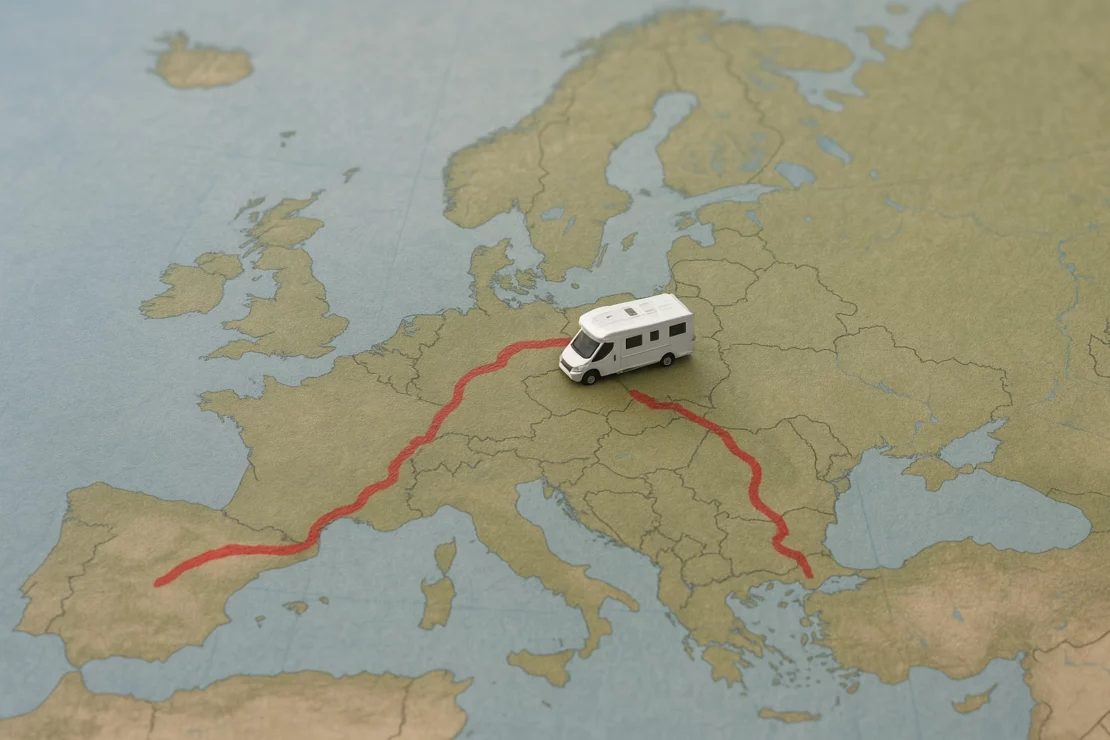
- Map your route and research every country you’ll drive through: check for tolls/vignettes, required stickers (e.g., UK sticker, emissions sticker), speed limits, drink‑driving limits, road restrictions for large vehicles, required equipment for that country.
- If driving on the right‑hand side, check whether your headlamps need adjustment or a beam‑converter unit to prevent dazzling other road users.
- Ensure your insurance is valid for all the countries you plan to enter and that breakdown cover includes those countries.
- Make sure your documentation (licence, V5C, insurance proof, emergency equipment list) is current and accessible.
- If you have a motorhome with special configuration (large size, towing, converted van) or intend to stay extended periods in Europe, double‑check whether a CoC or other type‑approval documentation might be required in your destination country.
European Motorhome Travel FAQ’s
Not necessarily. If your motorhome is UK‑registered and you’re simply driving it through European countries, the more critical items are licence, insurance, registration (V5C), equipment and compliance with local rules. A CoC is more commonly required when importing/ exporting a vehicle or registering it in another country. However, it is wise to have the CoC available since certain countries may request proof of technical conformity.
Manufacturers are required to supply the CoC free of charge when the vehicle is delivered. For duplicates, you may contact the manufacturer with your vehicle’s VIN and pay whatever fee they charge.
Yes – vehicles over 3.5 t often fall under heavier vehicle regulations in some European countries: higher tolls, more restrictive road access, possible requirement for special stickers such as blind‑spot warnings, or additional licensing/permit requirements. You should check each country’s rules for motorhomes in that weight class.
If you have a UK photocard driving licence and you’re driving in EU/EEA countries (and Switzerland, Iceland, Liechtenstein) for standard purposes, you may not need an IDP. But if your licence is an older paper version, or you’re driving in non‑EU countries (or some countries may insist on one), check in advance. Also ensure the licence covers the category of vehicle (especially if your motorhome is large or towed).
You risk fines and may be barred from entering specific urban areas. Some cities enforce environmental zones for motorhomes, and the vehicle must display the correct sticker (vignette) for the emissions category. It’s best to check the websites of the cities you intend to visit or pass through.
Yes – for UK‑registered vehicles travelling abroad you should display the “UK” identifier on the rear unless your number plate already shows the UK identifier with the Union Jack. In some countries (such as Spain, Malta and Cyprus), the “UK” sticker is mandatory even if you already have the UK identifier. You should confirm this for each country.

Written by the Southdowns Motorhomes team. With decades of experience supplying premium motorhomes to UK and European customers, our team understands what makes a vehicle suitable for serious touring.